The Dispatch
— Field notes from That Is Interesting —
Exploring the Arctic: Our trip to Iceland and Greenland
I’d always dreamed about traveling to film on-location for That Is Interesting. But I’d never done so, until now. Greenland had always been a dream destination of mine. I didn’t know anyone who’d ever visited this icy giant, alone at the top of our maps. But the world’s largest island, a massive North American colony of a tiny European country, had long intrigued me. In 2023, Quinn and I decided to make it happen. We booked a flight to Nuuk, Greenland’s capital city.
But Nuuk is pretty isolated. It’s since had a major airport expansion, but when we visited, there were only two international flights into the capital - one into Copenhagen, the capital and largest city of Denmark, which Greenland is a territory of, the other into its chilly neighbor, Iceland. So, we decided, why not jump across the North Atlantic and travel to not one, but two islands in the far north?
Iceland was our first stop. We flew in from the US and landed in Keflavík, the small peninsula town home to the country’s main international airport. Out the window the skies were grey, the landing strip built atop black volcanic rocks. From there it was a 40 minute drive to our hostel in Reykjavík. This bite-sized city, with its colorful buildings, gloomy, unforgettable Hallgrimskirkja, and Perlan, a hilltop museum built atop a circle of water tanks, was a great first stop. Taking up a small peninsula that juts off into the Atlantic, we enjoyed some Icelandic hot dogs, wandered around its tiny downtown, relaxed in a bathhouse, and enjoyed the long summer sunsets over the bay of Faxaflói.
But Iceland is best seen venturing beyond the city where most Icelanders live. Few places can match its otherworldly volcanic landscapes, and to see the ice caps, waterfalls, volcanoes and fjords that cover the island, it’s best to hop in a car and drive the Ring Road. The road - which isn’t always completely paved, is nevertheless the best way to see the island, and beyond Reykjavík and nearby tourist hotspots like the Blue Lagoon, you’ll mostly have it to yourself. With first come, first serve campgrounds scattered all throughout the island, Iceland makes it incredibly easy to road trip, especially if you visit in the summer and take advantage of the extra daylight of the midnight sun.
After walking between the North American and Eurasian Plates at the ancient outdoor parliament of Thingvellir, our first night on the road took us north to the spectacular Snaefellsness Peninsula, where we camped in Grundarfjörður, a fishing village under the shadow of the iconic Kirkjufell. After checking out Erik the Red’s house and taking a dip in the Arctic Ocean, we spent the night near Varmahlið on Iceland’s north coast, and got some stunning mountain views from a hot spring over a waterfall. Day 3 on the road took us to Akureyri, the country’s fjordside second city, on a hike up a volcano at the pockmarked lava field of Mývatn, and to our campsite in a remote meadow called Grímsstaðir.
The next day, we visited the basalt column canyon of Stuðlagil, drove a winding road through the Eastfjords, and spent the night at the base of the monolithic Vestrahorn, which looms over the black sands of Iceland’s south coast as well as an abandoned movie set and NATO base. Our fifth day of driving took us along the base of the massive ice cap of Vatnajökull, where we watched icebergs calve and float out to sea in the bay of Jökulsárlón, and saw walked the basalt hexagons of Kirkjugólf. Our last night on the road was in the small village of Vík i Myrdal, with its black sand beaches, lavender fields, and beautiful little church. Iceland’s huge expanses of volcanic black sands are deposited by the ice caps too, where we walked out to the wreck of a crashed DC-3 airplane. Before driving back to Reykjavík and bidding Iceland farewell, we visited two of Iceland’s most impressive waterfalls - Skógafoss and Seljalandsfoss, as well as the place that gave geysers their name - Geysir. Then it was time to hop in a propeller plane and cross the Denmark Strait for Greenland.
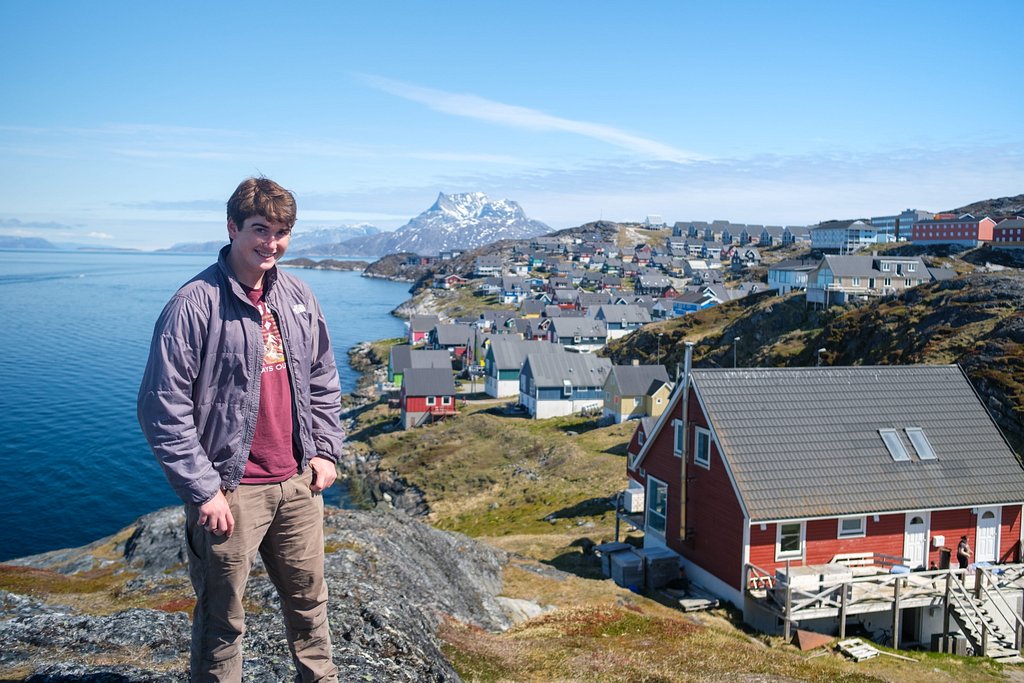
This was a year before the Nuuk Airport got a major facelift, and we touched down onto a runway carved into the rock, walked across the tarmac to a tiny terminal, and hopped in a cab for the city. Greenland’s capital is tiny yet massive - a town of just 20,000 people yet at the same time a multiethnic, multilingual capital city home to its main hospital, university, and more than a third of its population, who hail from all over the island. Multicolored houses sit beside tall apartment blocks and downtown high-rises. All are perched atop rocks. Besides some mosses and grasses, there’s little plant life, no trees, and not much in the way of soil. Old Nuuk is the city’s historic district, home to statues, old cemeteries, colorful churches, and the country’s small waterfront National Museum. We scrambled up some rocks and caught a view of Sermitsiaq, the monolithic peak that looms across the Nuuk Fjord.
From the airport, we hiked the route of a ski lift up a mountain overlooking the city and the fjord. Gazing out over the dark rocks of the countless uninhabited islands stretching out into the horizon, it’s hard not to wonder how we got there. Unfortunately, our visit to this beautiful island with its kind people, fascinating culture, and incredible scenery had to come to an end. When we were there, Greenland only offered flights to one other place, so we packed our bags and headed to the country Greenland is a territory of. That’s right - Denmark was next. But that’ll have to wait for the next Dispatch. In the meantime, watch our videos on Greenland and Iceland right here:
Try:
-
Enjoy an Icelandic hot dog from one of the country’s countless hot dog stands. They’re very different (I’d say better) than what you’re used to.
-
Take a bite of some fermented shark. I’ll be honest, this stuff is really, really bad. Its aftertaste feels like ammonia. But where else could you try a shark that’s been buried underground so it’s no longer poisonous?
-
Wash it down with some Brennivín, the caraway spirit that’s Iceland’s national drink. Be warned - they don’t call it “the Black Death” for nothing!
-
Greenland has some of the best fish you’ll ever have. Try anything with smoked salmon on it.
-
Eat some reindeer! You’re in the Arctic, after all.
Do:
-
Take a relaxing soak in a bathhouse (avoid expensive ones like the Blue Lagoon). In Reykjavík, many of these are public pools that you can visit for a small fee. Basically like a YMCA, but with geothermal hot tubs and saunas!
-
Rent a car and drive the Ring Road. There’s no better way to see the country.
-
Take a soak in one of Iceland’s countless natural hot springs!
-
Go for a hike in the mountains above Nuuk
-
Watch the midnight sun dip briefly below the horizon and rise again
-
Scramble up on some rocks and enjoy the view of Greenland’s colorful architecture
Get Ready for:
-
The sulfuric smell of Iceland’s showers - all the country’s hot water is geothermal!
-
Icelandic roads that suddenly turn to gravel
-
Lots of Thai restaurants in Nuuk - Greenland has a large population of Thai immigrants
-
Repurposed shipping containers all throughout Nuuk - leftovers from its massive fishing industry